Monday, August 14, 2017

SATB2 Clinic Visit


During our SATB2 conference in Little Rock, Arkansas 2 weeks ago, we had the privilege of participating in the first ever SATB2 clinic! Dr. Z (the geneticist that is heading up the SATB2 research) organized it for the families who would be attending.


After filling out some paperwork, we were taken back to a room where different teams/ doctors/ specialists would come see Chelsea. We had an early 8 am appointment, so we didn't have to wait a long time.


The first person to show up was actually the program coordinator, and she briefly explained how the clinic would work, and who we would be seeing. She also said that we could get bloodwork and dental x-rays done that day too, if we wanted.


Chelsea played a few games while we waited for the first team of doctors to show up- family name matching and drawing.


The ENT team was very nice- looked at Chelsea's ears, nose, and throat, and asked some questions for research, but I felt like we weren't very helpful. Chelsea has been super lucky, and never had an ear infection in her life, no breathing difficulty, nothing. So they checked her out, said that everything looked good, and left after maybe 5-10 minutes.


We had to wait a little longer for the speech pathologist. Fortunately, we had a big backpack full of games, and Chelsea was happy.

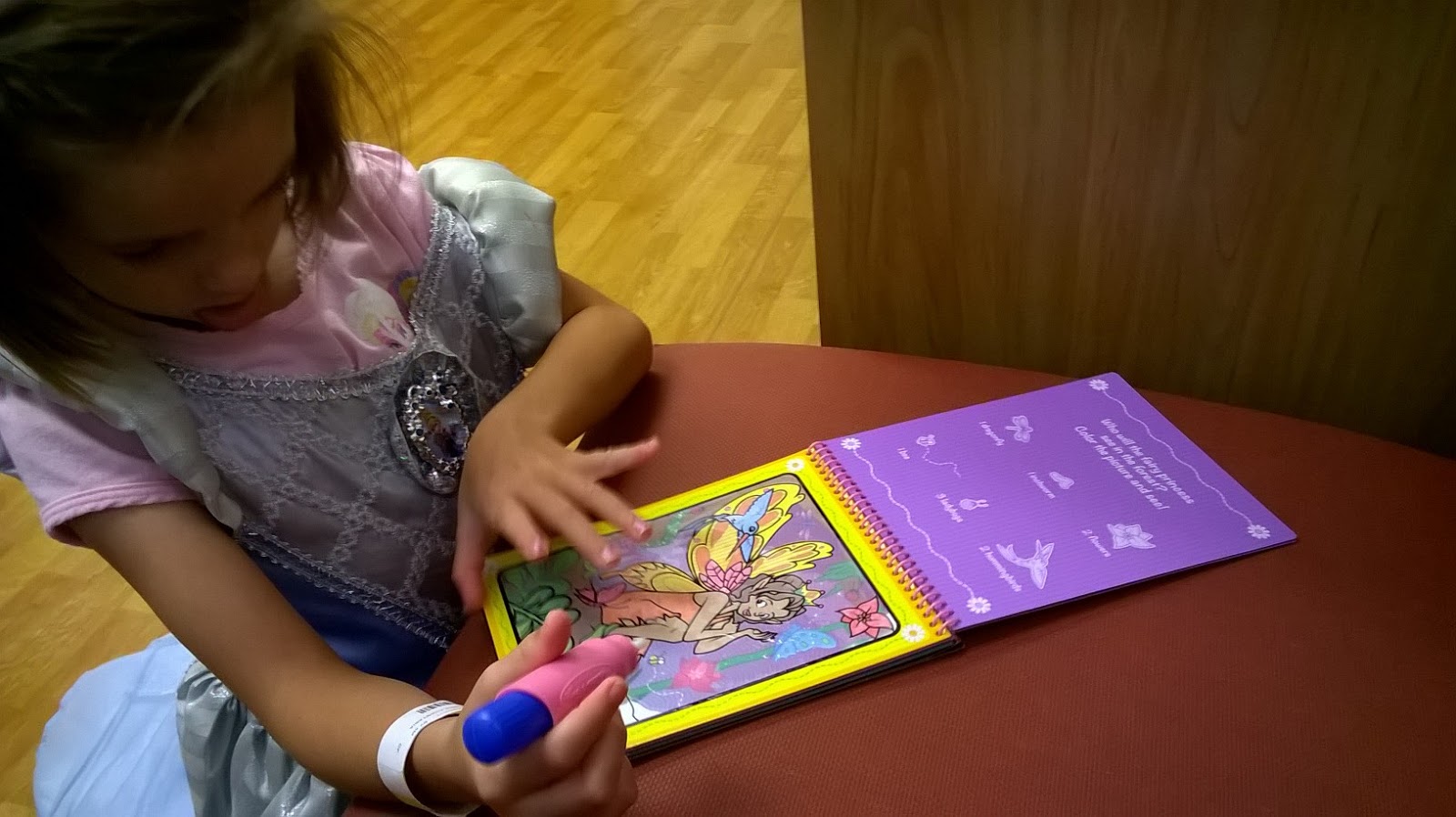

The speech pathologist and Chelsea got along very well, and this was the longest appointment we had. The SLP let Chelsea look in her mouth before trading "jobs" and looking into Chelsea's mouth. SATB2 kids usually have a cleft or high palate; Chelsea's is high. She used to stash food there for ages. Gross!


After checking out her mouth, she got out some flipcharts and had Chelsea identify objects, starting with nouns and colors, then moving up to verbs and more complex words like "find 'around'". But Chelsea worked hard and did her best!

We discussed what we have done for speech therapy (PROMPT, oral-motor, K-SLP apraxia, frequency, length of sessions, PECs, visual cues, ASL...)


We had about a 30 minute wait after that appointment, which was plenty of time to take Chelsea potty and feed her some snacks. She loved pretending to be a princess on her "throne".


Naturally just after eating her snacks, then dental team came in. They were very nice about ignoring the food I am sure was still on her teeth, and looked at everything, noting about her two front teeth that got knocked out last year, asking about x-rays, etc.


The lady on this team was especially good with Chelsea! She pulled out a little mirror and told her it was Snow White's magic mirror, and Chelsea was super compliant after that, because here was a doctor that knew about princesses!


We got x-rays done, which I had never attempted with Chelsea awake before! The only other time we had x-rays done was when she had her 2 teeth extracted under sedation, and the x-rays we got this time were much better!
I was surprised at how well-behaved Chelsea was for this! She was standing stock still on tons of paper, her teeth clamped around part of the machine (I don't know the name), and staring at me, as if asking "What on earth am I doing this for, Mom?"


The marketing team came in to ask some questions about how the clinic was going, what it meant to be with so many other SATB2 families, and how we liked the hospital. I told them how impressed I was at the level of care Chelsea was receiving, and how hard Dr. Z worked to coordinate everything.

Finally, it was time to see Dr. Z! He looked at Chelsea's hands, feet, and back (she freaked out that we had to unzip her princess dress for about 10 seconds), and asked about Chelsea's history- if she drooled excessively, when it stopped, her seizures, osteopenia, etc.  He asked if we had any questions, but I knew he was giving a presentation the next day about SATB2, so I said that no, I was sure they would all be answered the next day.

The very last thing we did was get blood work done to check Chelsea's vitamin levels, but no pictures of that, because at this point, Chelsea lost it. They brought out the needle, and it took me and 2 nurses to hold her down, plus another to draw the blood.

Chelsea gets STRONG when she wants to! I never thought that a 38 pound little girl would be able to hold her own against 3 adults, but she can! Whew! These pictures were from earlier in the day; she was very upset at this point, and as we left, she turned and yelled at the nurse who drew the blood "You MEAN!!!!"


She settled down after some lunch and rest, but she reminds me all the time how tough she can be:


Monday, August 7, 2017

SATB2 IEPs

At the first ever international SATB2 Associated Syndrome conference, we had several sessions to learn about different aspects of parenting a child with special needs.

This month, I will be blogging about the different sessions in the conference. So to start, all about IEPs!


The First IEP- Getting Started
  • Every child with a disability ages 3-21 should have an IEP

  • An IEP is an individual education program. The services they receive at school, and the goals they are working on, basically

  • If your child is younger than 3, contact your early intervention program manager to see which district you are in, if you don't already know

  • The best thing you can do to prepare for your first IEP is to get training! Wrightslaw.com has training all around the United States that are the BEST


Your First IEP Meeting
  • NEVER say that you want what is "best" for your child. You want what is "appropriate". In school, your child is guaranteed an "chevy" education, not a "Cadillac" one. So if you say you want what is best, they will say no

  • Bring in letters from doctors, specialists, and therapists, saying what is appropriate, and what is not appropriate. Ex: "4 (30 minute) sessions of 1:1 speech therapy with an apraxia trained specialist is appropriate for a child with SATB2 Associated Syndrome. Group speech therapy is not an appropriate treatment for this child's educational needs."

  • List the goals you want your child to work on. If you need ideas, look online, ask other parents, or ask your private SLP/ OT/ PT for ideas. You can also ask for training for yourself and/ or the team members

  • Bring support and food! The food is for the team, and helps break the ice. For support, you will feel overwhelmed, and especially if tension is high, you may draw a blank when you start talking.

  • Never sign the IEP at the meeting. I will sign the attendance form, but not the actual IEP. I always tell them that it is a lot to take in, and emotions can run high, so I want to take it home, review it, and then bring it back later signed.


Common IEP Problems
Q: The school is taking forever to test my child!!!
A: Schools have to adhere to specific deadlines for when you request your child to be tested (in writing!) and the delivery of that service. Look up that timeline and you may need to gently remind them of when your child needs services by.

Q: My child is being offered almost no services! Doesn't my child qualify for more?
A: Remember that you are part of the team! The head of the team, really! You are the expert on your child, and on SATB2! You know what treatments are most effective, so tell them what works! IEP teams are required to consider all info you bring to the table, and use the most effective methods approach


Q: The district says that this is all they can offer, I can take it or leave it. What do I do? I don't want my child to get nothing!
A: The way I deal with this is consent (initial) to parts of the IEP, and do a 6-8 week trial for the other parts I don't agree with. Schools are much more willing to do trials

Q: I don't want my child to lose out on time in mainstream, but they also need related services (speech, OT, reading, etc). How do I do both?
A: In preschool, I requested that I bring Chelsea in early or stay late so she gets full preschool time, and her services. Some schools were okay with that, others really fought back. Depends on the team. In Kindergarten, I had the SLP come into lunch/ recess/ mainstream and work on functional speech goals "Can I play with you?", things like that. Another idea that I loved that was given at the session was for your child to bring a friend to therapy so they don't feel like they are missing out.

Q: My child was denied services, but they are so far behind!
A: Draw a bell curve! In the Wrightslaw book "Emotions to Advocacy", there is an excellent chapter on interpreting test scores. If your child falls in the 7th percentile or below, they should get services in that field. Show the school where your child is, and how they qualify.


ESY: Extended School Year
All of our SATB2 kids should qualify for ESY! In the 1994 Maryland case of Reusch vs. Fountain, there were 6 criteria listed to qualify a child for ESY (because we shouldn't have to "prove" that our child will regress over breaks!). They are:

1. Regression (schools will usually only use this one)
2. Degree of progress toward IEP goals
3. Emerging skills/ breakthrough opportunities
4. Interfering behaviors
5. Nature and/ or severity of disability
6. Special circumstances

Now, ask exactly what ESY entails in your district!!! Does that mean they get to pick 2 goals out of their entire IEP that they "won't regress" on? In ESY, kids are not required (and sometimes discouraged) to make progress.

When I've done ESY in the past, I just requested to bring Chelsea in for 1:1 therapy, then did a homeschool setting. Boom, about 2-3 hours of therapy each week for free!!!

Getting Appropriate Services
  • Okay, so now you say "Yes! I want all this for my child!! How do I get it?"

  • Bring in studies!!! The law requires IEP teams to consider information that the parent brings to the table, and encourages most effective treatments

  • So have professionals write in letters about what is appropriate treatment for your child!

  • Keep a paper trail! I log every conversation I have with the school, so that I can go back and show them what was said. If it isn't in writing, it didn't happen!

  • I also photograph and document any bruise/ scratch Chelsea comes home with. The school knows I do this, and is VERY transparent about any injuries she has at school. They terrified me once with me having several missed calls, emails, and voicemails from the school nurse, who finally said that Chelsea got an ant bite on her finger. But better that than unexplained bruises!

  • Use parent addendums! I'm guessing maybe 2% of parents do this, but it is gold! After an IEP (and I don't sign during the meeting), I go home, listen to my audio, and type up a parent addendum. You can put anything you want in this- mention emails, phone conversations, anything. Then staple it to the IEP (and have a copy for you!) and return it.
Best book to learn sped law

  • Don't be limited with your IEP! In Chelsea's IEP, I have listed that I will get training from the SLP/ OT regularly, that I get monthly speech videos, the therapists get training, there is push-in/ pull-out, accommodations, modifications...

  • Be flexible! This one may seem to not go along with everything else I have said, BUT- having a good relationship with the team is the very best thing that can happen! It is SO worth it to not get everything I wanted, but most, and keep those relationships strong. Bad relationships just end up in a downward spiral for everyone. I've been there. It is no fun at all.

  • Flexibility Example: I wanted all 1:1 speech for Chelsea, but told the SLP that she could do some group speech (we wrote in 120 minutes weekly of speech, with 20 minutes maximum of group speech). I told her that I appreciate her work, and that sometimes Chelsea would get sick, or she would, and I don't want her to stress about minutes. I really don't! So now she is more relaxed, Chelsea gets speech, and we stay friends
Excellent book to help with IEP process!

  • At IEP meetings, I try to bring food for people, be nice (I do try, I promise!), etc. If they want to fight, I am more than willing to go up to bat for Chelsea, but would much rather keep things friendly

  • Decide how you will communicate. Do you want a two way binder? Weekly phone call or email? Wait for 6-8 week progress reports? A "circle the answer" multiple choice page to ease the burden or your child's overworked teacher? What works for you?

  • Also, do you know that little grey pamphlet they give you each year? The super boring looking one that no one ever reads? That is solid gold! It tells you about what to do if you and the school disagree.


  • IEEs (Independent Educational Evaluations) are private evaluations that the school pays for, if you disagree with their assessment of your child. Just make sure that the school doesn't send you to a different school district. You can choose the provider (within guidelines, of course). Please be aware (especially California and New York dwellers), that the school can sue you to prove that their evaluation is adequate. But most won't. Too much hassle

  • Know the law!!! What I have found is a good trick is to look up 2-3 laws, and be able to quote them. Learning to say something like, "In the 1994 case of Reusch vs. Fountain, there were 6 criteria laid out for qualifying a child for extended school year, and you are only talking about one. Can we discuss the other 5?" isn't hard. Write it down and say it 10 times in front of the mirror. But it SCARES THE WAJEEBIES out of school

  • Finally, be organized! It is much more impressive to schools when you can whip out an evaluation/ contact log without effort rather than rifling through a huge bin or not having any papers. Organization helps with applying for grants and for government programs, with going back to school, doctors... everybody! I blogged about how to organize papers HERE and HERE


Thursday, July 27, 2017

Special Needs Mom Pressure

Recently, I read an article about the mixed messages for "millennial" moms, which I am. Part of the article:

"Watch your kids closely and constantly. There are tricky people lurking among the aisles of Target. But not too closely. Come on helicopter mom. Calm down!"

And...

"Babies do not spoil. Hold them. Rock them. Co-sleep. Except don't. They need to self-soothe"

Seriously, I loved that article. It so perfectly captured what I have felt as I try to parent my two children who are polar opposites.


I wanted to add on just a couple of mixed messages that special needs moms get:

  • "Do home practice for therapy! You need to be working on schoolwork, speech, fine motor, and gross motor every day. Remember: don't miss a day or your child is doomed! But don't stress! Good grief, woman, why are you so tense??Just be happy!"


  • "Advocate for your child! You should be able to get everything and anything in your child's IEP; don't take no for an answer! But don't actually say anything to make anyone upset. School workers have feelings too, you know."

  • "You need to take time for yourself! Let the housework go, and focus on meeting your own needs. Except when someone is coming over, then everything needs to be immaculate."

  • "It is great that you are so open about your child's disability! We need to be aware of these things! But not too open, my goodness do you talk about anything else??? You need to be your own person."


Tuesday, July 18, 2017

Power Hour


My stress level tends to be highest right around dinner time- the kids and I are all cranky and hungry, we have been playing all day, so the house is a mess, which makes me more irritable, and so on and so forth.


For several years, I had tried various ideas of keeping the house clean, with maybe a week of success, then I would start forgetting, and get nothing done again, or get really annoyed all day long with the kids for making messes and not cleaning them up.


I am still far from perfect, and there are LOTS of days when Daddy still walks into a messy house. BUT- I finally found a method that we have been using for about a year that works! We call it "Power Hour".


We do Power Hour immediately after dinner, and everyone is supposed to help clean until the house is tidy. The hardest part of Power Hour, no question, is getting the kids to help. It is so much faster and easier if I do it all, but then the kids keep making more messes and I get seriously annoyed, and they learn no responsibility.


So Power Hour started out with me doing hand over hand with Chelsea (and sometimes her brother, but he got it pretty quick), every day, putting her clothes in the laundry basket, cleaning up her toys, etc.


Last night was the most successful Power Hour we ever had, and it was very encouraging! Chelsea put all the books into the bookcase, vacuumed, put clothes into the washer, washed the table, and made her bed.


Her brother took out the trash, folded a load of laundry, and helped load the dishwasher.


No, none of their completed jobs would be professional. Yes, the books were put in horizontally rather than vertically, and the folded laundry was mostly inside out, BUT they are learning that in our family, we work together to keep the house clean! And I am very proud of each of them for it!


On top of that, I can enjoy my evenings after the kids are in bed rather than clean constantly and get really resentful.
 

Thursday, July 13, 2017

Waiting Room Activities

As a family with a special needs child, we spend a lot of time in waiting rooms, during medical tests, during therapy, or just waiting our turn because doctors often run behind while they strive to give high quality service to each patient. Any family with children of any ability level can attest that waiting can be very difficult!


To avoid the boredom (and consequent misbehavior), I usually bring along a backpack of activities, usually for my son while we wait for Chelsea in therapy. He is one of the highest-energy kids I have ever met, so it is a handful to keep him occupied wherever we go!

I won't go into the activities that everyone already does because yall ROCK at parenting- books, little action figures/ toys, and coloring books.


1. Puzzles
Our favorite puzzles to bring are big floor puzzles, because we don't have a good spot for them at home, but the hard floors at doctor/ therapy places are perfect! We also have brought pieces for little puzzles in baggies and work on those.


2. Math Games
This is our favorite! For the first game "Dice Rolls", we use a big squishy die, and we take turns throwing it across the room. We then add the number to our score. Super easy, and lots of energy is burned by throwing the dice and catching it.


Similar to Dice Rolls is "Pass the Pigs", an actual game that I bought (okay, at a yard sale because I am cheap), but SO MUCH FUN!!! Instead of rolling dice, you roll these two tiny piggies, and how they land determines your score. We play a somewhat simplified version to accommodate kindergarten math skills.


3. Stilts/ Stairs
Remember how my son is super high energy? Sitting still in a waiting room is not a fun thing for him. So we will sometimes find stairs to climb, or bring a pair of little stilts so he can walk on around the waiting room, or even better, outside the therapy center! Pretty much any idea we can do to keep him from exploding from his zest for life. These stilts aren't the ones we use for the waiting room, but you get the idea.


4. Whatever Your Kid Loves!
One of the most popular things that I see in waiting rooms is cars. Other kids love zooming them around on the hard floors! Little man is totally indifferent to cars though. His car nut daddy may or may not be disappointed.

I've also brought playdough (and folded up wax paper because I get anxious about making a mess). But a couple little jars of playdough and a bag full of letter cookie cutters, and we practice spelling words in a fun, kinetically-learning way!

Right now, my little nerd wants to learn chess, so we play chess.


5. Mental Agility Games
My son loves to think of something and then give clues "What is a sport where girls wear leotards and flip on bars?" or "What state do we live in?" and calls the game "Guess What I'm Thinking"

We also play I spy, or hide and seek with a small toy, or one of my favorites that he is still learning- Mental Tic Tac Toe! This is a game where you both have to imagine a game and person X says, "X in middle" followed by the next "O in top left corner"


6. Building materials
I never knew how very "hands-on" boys were until I had my little man! He loves bringing his building balancing men, and legos, and magna tiles to work with. He is ever calling "Mommy, look at THIS!!! Will you remember it? Take a picture quick!"


7. Write and Illustrate A Book
We have some blank pages stapled together, and will bring one of those and some markers, and write a book and give it drawings! One of the most recent creations was all about his "Texas Grandma", and all the things he loves about her. Kinda hard to see, but this is the picture he drew for the cover:


8. Busy Bags
We have a big box full of these, and it is super easy to grab a few and toss them into the backpack on the way out the door. Some of our favorites are family name matching, Velcro craft stick building, and Build a Pizza. I blogged about different busy bag ideas HERE and HERE.


9. Magnetic Games and Water Wow
These are some products that I felt were absolutely worth the money! Chelsea's favorites are the dress up Disney princesses with all the different outfits. She has several and LOVES them!


My son really likes the Melissa and Doug Water Wow books. They come with a little paintbrush you put water into, and then they paint a scene using just water, then dries so you can use it again!


10. Lacing Boards
I'm always looking for ways to improve fine motor, and lacing boards are perfect! I often find them at local kid resale shops for a fraction of the price new, and in great condition!


11. Puppets for a show
Puppets are easy to squish into a backpack, and fun to get out and put on a play with! My son always ends up having one puppet kill all the other ones. I'm convinced it is an inherent guy thing. I never taught him that, he watches zero violent TV, and still is obsessed with fighting, even when it is adorable little animals. Go, testosterone, go!


12. Stickers (re-useable or in baggie with paper)
One of the busy bags I use a lot is super easy to stock up- just stickers and pieces of paper. I also have Melissa and Doug reusable stickers that are fun too. My little guy loves the pirate one! 


13. Portable Guess Who
Just started teaching this one to my little guy and he likes it! It used to be one of my favorites when I was younger, so it is fun to share something from my childhood with him.


A Few Tips:
  • Use a backpack! Forget bags! I hated bringing bags because I was always being asked to fill out papers and my bag would always slip down my arm and annoy me. But I am easily annoyed, so maybe that is just me

  • Yes, there were times when I am so exhausted from parenting that I will take along the iPad and have my son play some games on it while I took a 20 minute cat nap curled up in a chair. But I try and avoid screen time as much as possible- it gives Chelsea seizures and makes may little guy cranky

  • When I am trying to figure out fun portable ideas, I usually get onto pinterest and tap the minds of truly creative people. I am just a copy cat is all.

  • My mentality is that this is time for just my son, since Chelsea takes up so much time and energy at home. I usually follow his lead as to what he would like to do. He almost ALWAYS chooses Pass the Pigs